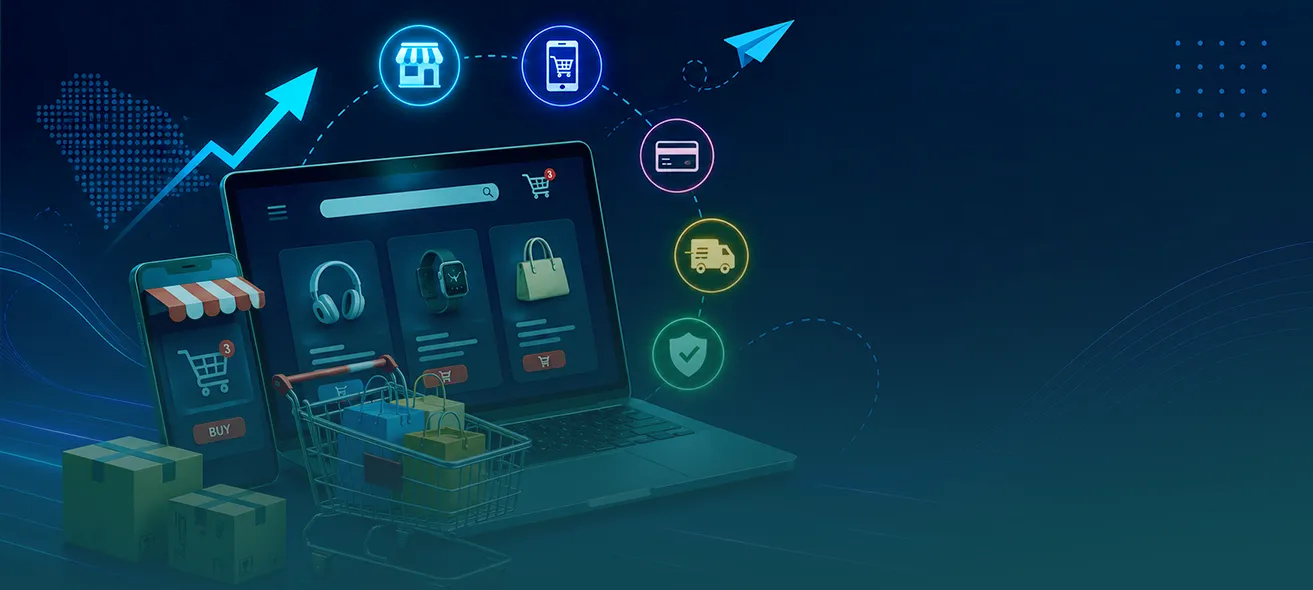
Did you know that the Saudi market alone is witnessing an annual growth in e-commerce exceeding 15%? We are not just talking about a digital phenomenon, but a sector that is reshaping the region’s wealth.
If you are wondering what e-commerce is and how you can turn your traditional store into an AI-powered profit machine that saves you 60% in costs, you are in the right place.
In this guide, we will take you from simple definitions to smart logistics strategies that ensure your continuity in a market that shows no mercy to the hesitant.
What is E-commerce?: More Than Just Selling Online
E-commerce is defined as the process of exchanging value—whether physical goods, services, or even data—over the internet.
However, in today’s reality, this concept has expanded to include every digital touchpoint; from your smartwatch ordering your coffee with a single tap, to Unified Commerce systems that connect your warehouses, online store, and physical branches into one platform.
To clarify the vision before we detail the complex types, we have prepared this comparison table showing why investors are currently rushing to leave traditional trade and catch up with the digital wave:
Table: The Difference Between Traditional Trade and E-commerce
| Comparison Point | Traditional Trade | e-commerce |
| Geographic Scope | Limited to the project’s location and the surrounding area. | Global; your store is open to anyone with an internet connection. |
| Operating Hours | Fixed (usually 8 to 12 hours). | 24/7;Your store sells for you even while you sleep. |
| Operational Costs | High (rent, labor, bills, decor). | Very low; a digital platform and a smart warehouse. |
| Data and Analysis | Difficult to track and often relies on guesswork. | Accurate and real-time; track every click the visitor makes. |
| Speed of Expansion | Slow and requires huge investments to open branches. | Super fast; a few clicks and you reach new markets. |
How Did E-commerce Evolve? (From the First CD to the AI Era)
It didn’t starte-commerceas the giant we see today; it began with a timid step in 1994, when a young American sold a CD by the singer “Sting” for $12.48 via a primitive website. That was the spark that ignited the “dot-com” boom, followed by giants like Amazon and eBay that changed the rules of the game forever.
Since then, the sector has undergone radical transformations; from simple websites displaying static product images, we have reached the era of Artificial Intelligence (AI) today, which automates product descriptions, predicts customer behavior, and manages warehouses without human intervention.
This evolution was not just an increase in sales, but a transformation in the “philosophy of selling” itself.
Stages of Transformation: Single-Channel vs. Unified Commerce
To understand where we stand today, you must realize that sales strategies have gone through four pivotal stages, and moving from one stage to another is what makes the difference between a successful store and one struggling to survive:
- Single-Channel Commerce:This is the old traditional pattern, where the merchant has only one sales channel (either a physical store or a simple website), with no connection between them.
- Multi-Channel Commerce:Here, merchants began appearing in multiple places (website, mobile app, physical store), and despite having multiple channels, they operate as isolated islands; inventory on the site is unaware of what was sold in the store, causing data conflicts.
- Omni-channel Commerce:This is the stage that prevailed in the last decade, where channels are linked to provide a consistent customer experience; you can search for a product via “Instagram,” order it via the “website,” and pick it up from the “store.”
- Unified Commerce:This is the pinnacle of the technical hierarchy we live in now; here, we don’t just link channels, we unify them into a single backend platform.
- The Major Advantage:A single system that manages (inventory, sales, customer data, and marketing) in real-time. If a customer buys an item from your store in Riyadh, it will immediately show as out-of-stock for a customer browsing from Dubai at the same second.
The shift towards Unified Commerce is the primary driver for collecting big data that allows you to provide a personalized shopping experience, effectively increasing your Conversion Rate.
The 10 Types of E-commerce: Discover the Most Suitable Model for Your Project
Many believe that e-commerce is limited to a store selling to people, but the reality includes a complex and profitable network of models.
Your understanding of these types is what will determine your budget, the type of your team, and, of course, your marketing strategy.
Traditional Business Models (B2B, B2C, C2C)
These are the fundamental pillars upon which the industry was built, and they are the most stable in the market:
- Business-to-Consumer (B2C):The most famous model (like Amazon and Noon), where your company sells products directly to the end customer. The system is characterized by speed and a heavy reliance on emotional marketing.
- Business-to-Business (B2B):Dedicated to wholesale and raw material supply (like Alibaba). Deals here are massive, and the focus is on building long-term relationships with other companies.
- Consumer-to-Consumer (C2C):Platforms that allow individuals to sell to each other (like “Haraj” or eBay). Your role here is to provide a “safe environment” for mediation and commission.
- Consumer-to-Business (C2B):When an individual offers their services or products to companies, such as freelance platforms (Mostaql) or photographers selling their photos to agencies.
Modern Trends: Digital Products and Social Commerce
Here lie the gold mines, where operational costs are almost non-existent and profits are doubled:
- Digital Products Commerce:This is the smartest model; you create an educational course, an e-book, or a design template only once, and sell it thousands of times. No shipping, no warehouses, and no spoilage.
- Social Commerce:Direct selling within apps (TikTok, Instagram). The customer buys with the click of a button while browsing content without leaving the app.
- Subscription Commerce:Getting recurring monthly income in exchange for a service or a box of products that reaches the customer periodically (like Netflix or healthy meal boxes).
- Educational E-commerce:Turning personal expertise into online academies, which is one of the fastest-growing sectors in the Middle East.
- Reverse E-commerce:Focuses on sustainability by selling used or refurbished goods, attracting the younger generation interested in the environment and saving money.
- Live Commerce:Selling via live streaming (like TikTok Live), where the audience interacts in real-time with the seller and purchases during the broadcast, which raises the conversion rate to incredible levels.
If you are starting with a limited budget, digital products and social commerce are your fastest gateways to achieving cash flow with very low risks.
Why Should You Start Now? Benefits of E-commerce
If you think the e-commerce train has passed you by, the truth is that the journey has just begun.
We are now in the digital maturity stage; where the consumer no longer hesitates to buy online, but has come to prefer it over traditional trade by more than 21% of total global retail trade.
Starting now means leveraging a technical infrastructure that is the most stable and secure in history, with the availability of AI tools that make managing a multi-million dollar store possible for one person from behind their computer screen.
Global Reach and Operational Costs That Cannot Be Compared to Traditional Trade
The secret to the superiority of e-commerce in 2026 lies in its ability to break the constraints of time and space while reducing expenses amazingly:
- Reaching a “Borderless Audience”:In traditional trade, you are a hostage to your geographic location, whereas in e-commerce, the Saudi market—which is the fastest growing in the region at a rate of 21%—is just a starting point. Thanks to advanced international shipping solutions, you can sell a product from “Riyadh” to a customer in “New York” as easily as you sell it to their neighbor.
- Collapse of Startup Costs:While opening a commercial shop requires exorbitant amounts (rent, decor, energy bills, and municipal licenses), you can launch a professional store via platforms like “Salla,” “Zid,” or “Shopify” for a very small fraction of those costs.
- Significant Savings:E-commerce saves up to 60%of fixed operating costs that eat up the profits of traditional stores.
- Human Resources Automation:Instead of hiring a large team to manage sales and warehouses, automation and AI systems process orders, track shipments, and answer customer inquiries via smart chatbots that have started to provide a highly accurate human experience.
- Scalability:If you want to double your sales in traditional trade, you will need to open a new branch and make huge investments. In e-commerce, expansion just means increasing the advertising budget or upgrading site servers, making your project’s growth ten times faster.
Google is now giving top priority to sites that provide a fast user experience (Core Web Vitals), so your investment in site speed is the cheapest marketing method to bring thousands of visitors for free.
E-commerce Conditions in Saudi Arabia: Your Legal Guide to Starting Immediately
The Kingdom of Saudi Arabia is today one of the most regulated and supportive markets for digital trade in the region. Compliance with legal conditions is not just a duty, but your ticket to gaining the Saudi customer’s trust, benefiting from bank payment gateways, and avoiding fines that could reach one million riyals.
Digital transformation under the supervision of the “Saudi Business Center” has also become easier and faster than ever before.
Steps to Obtain a Commercial Registration and Verify the Store
Regulatory procedures have evolved, and now you can start your activity completely legally in less than 10 minutes by following this path:
- Defining the Legal Entity:You can start with a freelance document if you are an individual (practitioner), or obtain a “Commercial Registration”(merchant) if you are establishing an institution or company; both give you the right to practice e-commerce legally.
- Obtaining Commercial Registration Electronically:Through the Saudi Business Center platform or the Ministry of Commerce website, you can issue your registration instantly. Make sure to choose the correct activity code (e.g., Internet Trade) to ensure your registration matches your store’s activity.
- Cost:Fees range from 200 to 500 riyals annually depending on the type of entity.
- Verification on the Business Platform:New registration on the “Marouf” platform has been stopped, and verification has moved entirely to the Business Platformaffiliated with the Saudi Business Center.
- Why Verify?To link your commercial bank account to your store, and to obtain the verified badge that appears to customers to increase credibility.
- Conditions:Verification requires a valid commercial registration or freelance document, and an active commercial bank account.
- Opening a Commercial Bank Account:You cannot use your personal account to receive store funds; Saudi law requires a bank account in the name of the establishment (or linked to the freelance document) to ensure tax and financial transparency.
- Compliance with Consumer Protection Policies:Your store must clearly contain:
- Contact details (phone, email, address).
- A clear exchange and return policy.
- Tax number (if you are registered with the Zakat, Tax and Customs Authority).
The deadline for correcting the status of unverified stores ends on July 30, 2026. Make sure the verification logo appears at the bottom of your store to avoid the site being blocked or payment gateways stopping.
E-commerce Logistics: How to Ensure Your Product Reaches the Customer Professionally?
Logistics is no longer just a shipping process; it has become the true face of your brand. The customer doesn’t remember what the site looked like as much as they remember when the product arrived and what the condition of the package was.
Thanks to the advanced infrastructure in Saudi Arabia, same-day delivery has become the new standard by which customers measure your professionalism.
Secrets of Supply Chain Management and Return Policies That Increase Sales
The secret to building a sustainable e-commerce empire lies in mastering two basic loops: how to get the product, and how to deal with the customer if they want to return it.
First: Secrets of Supply Chain Management:
- Smart Warehouses and Real-time Linking:Using systems ERPconnected to your store ensures you have “full visibility” of inventory. In 2026, successful stores are those that predict stockouts before they happen using AI, preventing lost sales opportunities.
- Last-Mile Delivery:Contracting with shipping companies that use “smart route optimization” reduces delivery time by 40%. In Saudi Arabia, relying on Pickup Points and smart lockers has become a preferred option that reduces costs and increases customer convenience.
- Diversification of Suppliers:Do not rely on one supplier. A flexible supply chain in 2026 is one that has local and international alternatives to avoid any disruption in global supply chains.
Second: Return Policies.. The Secret Weapon to Increase Sales:It may seem strange, but a flexible return policy increases your sales, not decreases them. 2026 statistics indicate that 67% of shoppers in Saudi Arabia check the return policy before adding a product to the cart.
- Building Trust:When you give the customer the option of “easy return with the click of a button,” you remove the “fear barrier” from buying, especially in the clothing and electronics sectors.
- Turning Loss into Loyalty:A customer who goes through a smooth and professional return experience is more likely to buy from you again by 95%.
- Automating Returns:Use platforms that allow the customer to print the return label themselves or request a representative via the app, which reduces the pressure on your customer service team.
Invest in writing a “Return and Shipping Policy” page with clear and simple words, away from legal complexities.
This page is not for lawyers, but is an “persuasion tool” that appears in search results when the customer searches for your store’s credibility.
The Future of E-commerce: How Will AI Change the Rules of the Game?
We are not talking about science fiction; in the year 2026, Artificial Intelligence (AI) has become the actual engine for every click the customer makes.
We have moved past the stage of building traditional stores and have entered the era of smart e-commerce that speaks the language of each customer individually.
Today, AI gives you the ability to turn silent data into smart sales decisions, saving you up to 60% of operating costs and putting your store at the forefront of competition thanks to hyper-personalization of the customer experience.
How is AI Reshaping the Shopping Experience?
- Digital Assistants and AI Agents:We have moved past the stage of primitive chatbots. Today, autonomous AI agents manage the entire customer journey; from helping them choose the right size based on their exact measurements, to negotiating discounts and completing the payment process via voice commands.
- Predictive Analytics:Major stores now use machine learning algorithms to predict what the customer will order next week. This allows products to be shipped to warehouses near the customer before they actually order them, making “delivery in less than an hour” a tangible reality in major cities like Riyadh and Jeddah.
- The Revolution of Visual and Voice Search:In 2026, customers search with images and sounds more than words. If a customer likes a shirt someone is wearing on the street, it is enough to take a picture for the AI to identify the product, find alternatives, and complete the order in seconds.
- Augmented Reality (AR) and “Virtual Fitting Rooms”:AR technology has become an integral part of e-commerce. You can now try on glasses, watches, and even furniture in your home via the phone camera with 100% accuracy. This technology has not only increased sales but reduced the return rate by up to 35%.
- Real-time Dynamic Pricing:Thanks to AI, prices in the store change instantly based on inventory levels, competitor prices, and demand volume. This ensures the merchant the best profit margin and the customer the best deal possible at that time.
Search engines in 2026 have become reliant on SGE (Search Generative Experience).
For your store to rank at the top, your content must be organized with very accurate Schema Markup data that AI algorithms can easily understand.
E-commerce Challenges: Obstacles You May Face and How to Overcome Them
Entering the world of e-commerce is not always a path paved with roses; with every huge profit opportunity, new challenges emerge that require flexibility and intelligence in dealing with them.
Currently, the challenge has shifted from simply creating a website to staying on top amidst fierce global competition.
Key obstacles and their strategic solutions:
- Fierce competition and price wars: With low barriers to entry, it has become difficult to stand out solely by offering the cheapest price.
- The solution: Don’t follow a “lowest price” policy; instead, follow a “highest value” policy.
Focus on building a strong brand and providing exceptional customer service that makes customers choose you even if your price is slightly higher.
- Cybersecurity and data privacy threats: Given strict regulations (such as the Personal Data Protection System in Saudi Arabia), any data breach can mean the end of a brand.
- The solution: Invest in reliable e-commerce platforms that provide SSL encryption and comply with PCI DSS standards. Ensure regular security audits for your store and train your team on data security.
- Rising Customer Acquisition Costs (CAC): Social media advertising has become more expensive than ever, shrinking profit margins.
- The solution: Shift from total reliance on paid ads to Search Engine Optimization (SEO) and content marketing. Start building an email list and a customer database to ensure repeat purchases without paying extra advertising costs every time.
- Logistics and product return complexities: Shipping delays or damaged products remain a major concern for merchants, especially during peak seasons.
- The solution: Partner with multiple shipping companies (multi-carrier strategy) to distribute risk. Use real-time shipment tracking software to keep customers informed, which reduces waiting anxiety and lowers cancellation rates.
- Cash on Delivery (COD) culture: Despite the evolution of digital payment solutions, a segment of the market still prefers COD, which increases the likelihood of order rejection and loss of shipping costs.
- The solution: Encourage digital payments by offering exclusive discounts or free shipping for digital transactions. For COD orders, use verification systems via WhatsApp or SMS to confirm the order before shipping.
E-commerce challenges are not the end of the road; they are filters that weed out unserious merchants and leave room for professionals who plan carefully.
Frequently Asked Questions (FAQ) about E-commerce
Here, we address the most important questions on the minds of beginners and professionals in the digital commerce world, with direct and concise answers:
What is the best type of e-commerce?
There is no single “best” type for everyone, but in terms of profitability and ease of implementation, selling digital products is the best for beginners because it requires no shipping or warehousing and can be sold thousands of times.
As for sustainability and massive growth, the subscription commerce model is the best for ensuring recurring monthly income.
What are the types of e-commerce?
Patterns vary depending on the parties involved in the transaction, the most prominent being:
- B2C: Business-to-Consumer (e.g., Amazon).
- B2B: Business-to-Business (e.g., Alibaba).
- C2C: Consumer-to-Consumer (e.g., Haraj).
- Digital Products: Selling e-books, fonts, and online courses.
- Social Commerce: Selling directly via TikTok and Instagram.
How do I start e-commerce from scratch?
You can start by following these practical steps:
- Market research: Choose a high-demand niche and analyze competitors.
- Obtain licenses: Issue a freelance permit or a commercial registration in Saudi Arabia.
- Prepare the store: Use ready-made platforms like Salla or Zid to save on technical costs.
- Verification: Verify your store on the “Business Platform” to increase customer trust.
- Marketing: Start targeted campaigns via search engines and social media.
What is the concept of e-commerce?
Simply put, it is any buying or selling of goods and services conducted via an electronic medium (the internet), including the transfer of funds and data necessary to complete these transactions.
What are the fields of e-commerce?
The fields are very broad and include all sectors of the economy, such as:
- Physical retail: Clothing, electronics, and furniture.
- Professional services: Consulting, programming, and design.
- Educational content: Training courses and online academies.
- Logistics and shipping: Companies that support the supply chain.
E-commerce is no longer just an option to increase income; it has become the oxygen for survival in the modern economy. Success today does not require the largest budgets, but rather intelligence in choosing the most appropriate model, commitment to legal regulations, and building real trust with the customer.
The Kingdom currently accounts for 45% of the volumee-commerce in the Arab world, and with the presence of AI tools and advanced logistics, there is no longer any obstacle to your launch.
Start today; verify your store withSard, choose a high-demand niche, and create your own story in the fastest-growing market in the region.