If you are tired of searching through repetitive articles and are looking for a definitive answer, you are in the right place. In this guide from Sard, we have decided to end your confusion. We won’t just list free e-commerce platforms; we will give you the full picture: how these platforms work, their types, when they are suitable, and when they become a barrier to growth—all of which ensure you build a professional brand and start your journey toward real profit for zero riyals.
Put budget excuses aside; front-row seats in digital commerce are no longer reserved only for the wealthy. Here are the options that will launch your project today.
What are free e-commerce platforms?
They are software and cloud-based applications that allow entrepreneurs and beginners to create a fully integrated online store to display and sell products online without the need to pay monthly subscription fees or setup costs.
These platforms rely on a smart business model, offering features like a dashboard, product addition, and a shopping cart for free. These tools are the top choice for anyone looking for free platforms that provide the necessary infrastructure for online selling; they are the golden gateway that enables you to take your business into the digital world with zero risk.
What are the most prominent e-commerce models that digital platforms rely on?
To understand how money and services flow online, it is essential to grasp the four basic business models that digital platforms use to connect merchants with their target audience:
- Business-to-Business (B2B) E-commerce:Relies on commercial transactions between companies, such as dealings between suppliers, factories, and wholesalers. It is often used for large deals, supply chains, and professional services.
- Consumer-to-Consumer (C2C) E-commerce:Based on selling products or services directly between individuals via intermediary platforms, such as resale platforms and community stores that facilitate buying and selling between users.
- Business-to-Consumer (B2C) E-commerce:The most common model, where companies sell their products or services directly to customers online through a flexible and fast purchasing experience.
- Consumer-to-Business (C2B) E-commerce:This model allows individuals to offer their services or products to companies. It is clearly visible in fields like freelancing, content creation, and crowdsourcing.
Save your budget for marketing: Reasons why starting with a free platform is a brilliant choice for your store
Turning toward creating a free store at the beginning of your journey is not just about saving money; it is a smart strategy to test the market and analyze customer behavior before injecting major investments. Among the most prominent advantages are:
- Reducing launch costs:Free platforms help you create an online store without needing a large budget for development or programming, giving you the chance to start with the lowest possible costs.
- Directing the budget toward marketing:You can invest your budget in paid ads, Search Engine Optimization (SEO), and social media marketing to attract potential customers.
- Testing the market before scaling:Platforms allow you to test products, analyze customer behavior, and identify the most in-demand items before making larger investments in the project.
- Reducing financial risks:Starting an online store with low costs reduces the level of risk, especially for new projects that are still in the stage of building an audience and achieving their first sales.
- Speed of store launch:Ready-made platforms provide tools and templates that help create a professional store in a short time, allowing you to enter the market faster.
- Ease of operations management:These platforms give you ready-made tools to manage orders, integrate payment gateways, track shipping, and improve user experience without needing advanced technical expertise.
- Building the brand gradually:Starting with low costs helps you focus on improving customer experience, gathering reviews, and building trust before moving to more advanced solutions.
Store infrastructure: Why is a platform not just a sales interface?
Choosing an e-commerce platform is not limited to the look of the store or how products are displayed; it extends to the technical infrastructure the project is built upon. Below are the most important elements to pay attention to when evaluating any platform:
- Hosting:The quality of hosting affects the store’s stability and its ability to handle high traffic pressure. Any weakness here could lead to the store going down and losing direct sales.
- Page Speed:Fast platforms reduce user wait time, which increases conversion rates and reduces the number of visitors leaving before completing a purchase.
- SSL & PCI Compliance:Having strong security layers protects customer data and increases their trust during payment, which is a fundamental factor in accepting online purchases.
- Mobile Responsive Design:Most purchases are made via mobile, so the platform must work smoothly on all devices without distortion or slowness.
- UX Performance:The faster and easier the interface is to navigate, the lower the bounce rate and the higher the chances of completing orders.
- Scalability:A good platform allows the store to grow in the future without needing to rebuild from scratch or facing technical issues when the number of products and visitors increases.
AI and SEO friendliness: How to ensure your store appears in zero-click results?
For your store to transform from just a passing website into a definitive answer chosen by AI for its audience, it must speak the language of structured data. This symbiotic relationship between your platform and search systems is what determines your sales volume, and it is clearly manifested in the following points:
Structured Data / Schema Markup
Some platforms add Schema automatically, which helps search engines understand product details such as price, ratings, availability, and category, enhancing the chances of appearing in Rich Results.
Improving search engine understanding of store content
The better the data is structured, the greater the ability of AI systems to categorize your products and link them to the appropriate search, which increases the accuracy of appearing before potential customers.
Meta Tags support
Good platforms allow control over titles and meta descriptions for every page, which is a fundamental element for improving store visibility in search results and increasing the Click-Through Rate (CTR).
Increasing Click-Through Rate (CTR)
When your store appears with rich information like price and ratings directly in search results, it becomes more attractive to users compared to traditional results, increasing the likelihood of visits and purchases.
Optimizing content for AI
Modern technical architecture makes product pages understandable not only to search engines but also to AI systems that rely on analyzing structured data to provide accurate and fast results to the user.
The Golden List: Best free e-commerce platforms for 2026
With the rapid development in the world of digital commercee-commerce, many platforms have emerged that differ in operation, level of control, and ease of use to suit the needs of both startups and large stores. Below, we review the leading platforms in each category to help you choose the most suitable one for your store:
SaaS Platforms (Ready-made)
These are platforms that operate on a monthly subscription system and provide everything a store owner needs, from hosting and design to payment tools, without needing technical expertise. Among the most famous are:
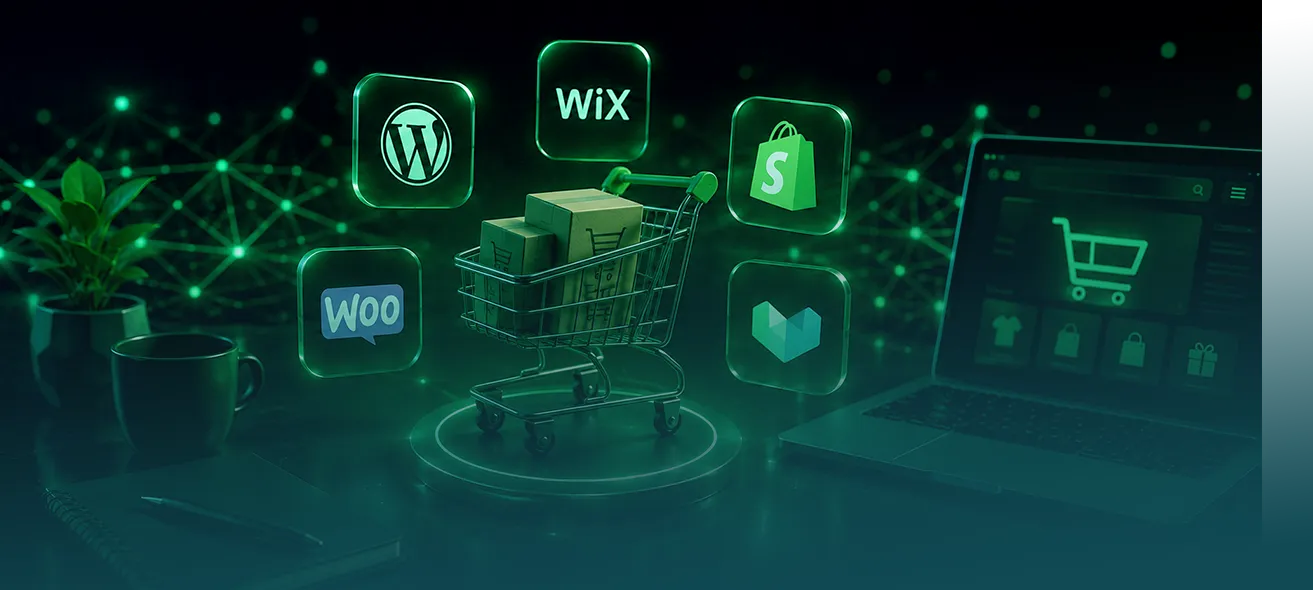
- Shopify: Considered one of the most famous platforms globally, it suits beginners and companies alike, offering thousands of apps that help increase sales and manage the store.
- Wix: A flexible platform that combines website building and e-commerce capabilities in an easy and simple way.
- Arab platforms like Salla and Zid:They offer solutions tailored to the Arab market with strong support for local payment and shipping gateways.
Specifically, the Salla Basic package is the perfect free option for opening a professional store without monthly fees.
They are characterized by ease of launch, fast store management, and a focus on marketing and sales rather than technical aspects.
Open Source Platforms
This type gives store owners full control over the store’s design and programming features, but it requires technical expertise or a development team to manage adjustments, hosting, and security. Among the most famous are:
- WooCommerce: A powerful plugin for WordPress sites that allows for the creation of a highly customizable online store.
- Adobe commerce) Magento): A professional platform aimed at large stores and enterprises that need to manage complex operations and high sales volumes.
Marketplaces
These are massive platforms that allow sellers to display their products within a single market that includes thousands of stores, giving them quick access to a large number of customers. Among the most famous are:
- Amazon:The largest global online marketplace that provides a huge customer base and wide sales opportunities.
- Noon:A leading platform in the Arab region serving markets like Saudi Arabia, the UAE, and Egypt.
- Jumia: One of the most prominent e-commerce platforms in Africa, providing a vast market for sellers.
Decision Compass: How to choose the right e-commerce platform for your project?
When comparing websites to create an online store, you shouldn’t just look for the most famous platform; you must look at the infrastructure that ensures your store’s continuity and growth. To choose wisely, make these criteria your primary reference:
- Budget and actual cost:Don’t just look at the subscription cost; calculate the total cost, such as plugins, hosting, transaction fees, and any future development services.
- Ease of use and management:If you are at the beginning of your project, the priority is a platform that gives you a simple interface and easy management without needing technical expertise or a specialized team.
- Scalability and growth:Choose a platform that doesn’t restrict you in the future, but allows you to add more products, expand your operations, and integrate advanced marketing and payment tools as your project grows.
- Integration with marketing and payment tools:The more the platform supports local payment gateways, SEO tools, and integration with ads and analytics, the stronger it will be in helping you achieve actual sales.
- Technical support and target language:Having fast and effective support, and an interface that supports your language and target market, is a critical element, especially in the early stages of operation when facing any problem.
If you are looking for a detailed comparison and deeper technical criteria, we recommend returning to our main reference on the best e-commerce platform to make your decision based on accurate statistics and real experiences.
Behind the curtain: Hidden costs that free platforms don’t tell you about
You must realize that owning a store without a monthly subscription fee does not mean the absence of operational expenses entirely. Therefore, it is necessary to understand the fees that may appear halfway through to avoid surprises after launching your store. Here are the most prominent costs you may face:
- Payment Gateway Fees:A percentage is often deducted from every sale in exchange for using electronic payment services.
- Paid plugins:Many essential features, such as advanced reports or improving user experience, are included in paid plans.
- Hosting and domain costs:Some platforms do not include hosting or a domain in their free packages.
- Professional templates and designs:Free templates are limited, while professional design often requires additional purchases.
- Marketing and advertising:The platform might be free, but attracting customers requires an independent marketing budget.
- Technical development and maintenance:Any advanced customization or technical troubleshooting might require a developer or additional subscriptions.
Most Important FAQs
Is it possible to create a completely free online store?
You can start with an online store that is free in terms of creation, but there are often subsequent costs such as payment gateways, hosting, or paid plugins when scaling.
Do free platforms support electronic payment?
Yes, most free platforms support payment gateways like Mada, PayPal, and Apple Pay, but some may impose fees on transactions or require the activation of an external payment provider.
What is the best free e-commerce platform in Saudi Arabia?
Platforms like Salla and Zid are among the most prominent options in Saudi Arabia, especially with their support for local payment and shipping gateways, and their ease of use in Arabic.
Can you profit from a free online store?
Yes, actual profits can be achieved, but success depends on choosing the right product and marketing strategy, not just on the platform being free.
When do I need to move to a paid platform?
When your store starts to grow and you need advanced features such as higher customization, professional reports, powerful integrations, or a larger number of products and visitors.
Book your seat in the future of digital commerce now!
At the end of this guide, it is clear that the budget barrier has completely collapsed. Today, with the existence of free and professional platforms, the question is no longer ‘Do I have the money to start?’ but rather ‘Do I have the will to continue?’
Don’t waste any more time in endless comparisons; real experience is gained through trial and error. Choose now from the sites we have reviewed what aligns with your vision.
Start turning your idea into a tangible reality… seats in the digital future are being booked now, and your success story is waiting for you to write its first chapters.