Can you imagine that every ‘Buy Now’ click is backed by an entire world you don’t see? Every time you purchase a product from your phone in seconds, you aren’t just dealing with an online store, but a massive system of operations, strategies, and companies working in the background like a tireless, intelligent machine.
But the real question here is: Do all these stores work the same way? And why do some e-commerce sites succeed while others fail, even when selling the same products? In this article from Sard, we won’t just provide definitions; we will show you examples of e-commerce and reveal how giant e-commerce companies operate, and how you can understand them in a smart way that helps you build a successful project from scratch.
What is E-commerce? A World That Brings Buying and Selling Together in One Place
Before we dive into examples and models, it is important to understand simply: what do we actually mean by e-commerce? It is the process of buying and selling products or services online, whether through websites, apps, or various digital platforms. However, it is actually much broader than just an ‘online store.’
This world does not operate on a single fixed system; rather, it consists of a set of store models and different operating methods, each with its own way of thinking about sales, marketing, and customer relationship management, making this trade a flexible and evolving ecosystem that constantly changes according to the nature of the market and user behavior.
Why has e-commerce become a force that cannot be ignored in the modern economy?
Did you know that e-commerce has become a fundamental element in building the global economy today and is not just an additional way to buy and sell? It represents a major shift in how markets work, allowing companies to reach customers around the world more easily and at a lower cost. Here is its importance:
- Expanding Reach: Enables companies to transcend geographical boundaries and reach new global markets.
- Increasing Revenue: Helps boost sales by making it easier for customers to access products and services around the clock.
- Reducing Operational Costs: Reduces the need for traditional storefronts and staff, lowering overhead expenses.
- Enhancing Competition: Creates a more competitive market, which positively reflects on product quality and pricing.
- Facilitating Purchasing and Payment Processes: Provides fast and secure electronic payment methods that facilitate the customer experience.
- Encouraging Innovation: Pushes companies to develop modern marketing methods and constantly improve products.
- Improving User Experience: Offers a more seamless, flexible, and personalized shopping experience tailored to customer needs.
In general, e-commerce is no longer just a luxury option; it has become a fundamental necessity for any business seeking growth and sustainability in the modern market.
What does e-commerce look like in reality? Examples to bring the picture closer
Now, when we talk about e-commerce, we are not talking about a theoretical idea far from our lives, but a daily behavior we constantly experience without noticing. It is present in every purchase, booking, or subscription we make online, to the point that it has become a natural part of our daily routine instead of traditional shopping. Among its most prominent real-life examples are:
- Buying clothes and shoes from online stores.
- Ordering food through smart apps.
- Booking hotels and travel tickets electronically.
- Buying electronic and home appliances.
- Subscribing to streaming services like movies and music.
These simple examples illustrate how digital commerce has turned into a powerful and practical alternative to traditional shopping, and sometimes even the user’s first choice.
1- Examples of E-commerce in the B2C (Business-to-Consumer) Model
The B2C model is considered the most widespread in the e-commerce world, where companies sell their products directly to the end consumer.
Global Examples:
- Amazon.
- Noon.
- Shein.
- Apple Online Store.
How it works:
The company displays its products directly to the user, while the customer makes the purchase decision based on price, offers, or user experience.
Why does this model succeed?
- Targets a large number of customers.
- Relies on repeat purchases.
- Easy to reach via ads and social media.
2- E-commerce Examples in the B2B (Business-to-Business) Model
In this model, the customer is not an individual, but another company that relies on services or products to support its business.
Famous Examples:
- Alibaba.
- SAP.
- Oracle.
- Software and business solutions companies.
How it works:
A company provides services or products to another company to help it with operations, management, or business development.
What distinguishes this model:
- High-value deals.
- Long-term relationships between companies.
- Purchase decisions based on analysis and study rather than emotion.
3- C2C (Consumer-to-Consumer) Examples
This model is based on direct exchange between individuals without an intermediary company.
Examples include:
- eBay.
- OLX.
- Facebook Marketplace.
The idea it relies on:
Anyone can sell or buy a product from another person directly through an online platform.
Key features:
- Great flexibility in dealing.
- Wide variety of products offered.
- Fundamental reliance on trust between users.
4- C2B (Consumer-to-Business) Model
It is considered one of the relatively modern models in e-commerce, but it has become important in the digital economy.
Key examples:
- Freelance platforms like Upwork and Fiverr.
- Designers and freelancers who provide services to companies.
How it works:
An individual provides a service or skill, while companies purchase it and benefit from it in their business.
In summary: These e-commerce examples show that it is not just one form, but a set of different models that serve diverse needs, whether the customer is an individual or a company. Each model plays an important role in shaping the modern digital economy in a different and complementary way.
The most famous e-commerce sites that have reshaped shopping in the world
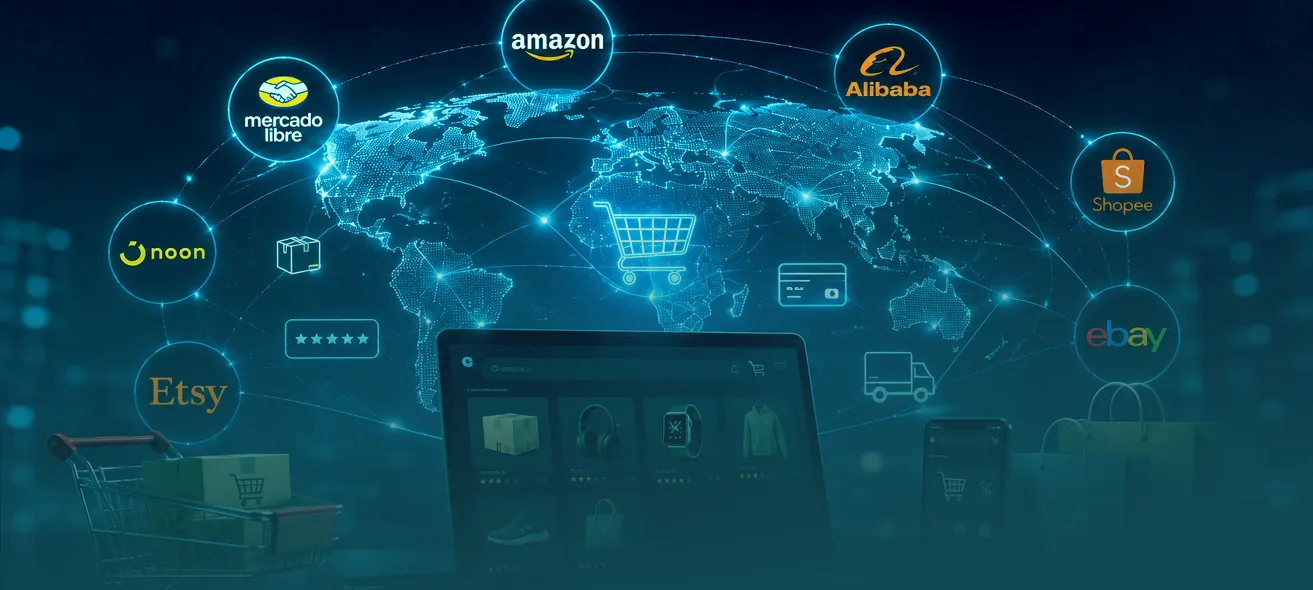
As we mentioned earlier, this trade is no longer just an idea or a means of buying and selling; it has become a massive industry driven by global platforms that have completely changed how people interact with shopping. Here are the most famous e-commerce sites around the world that manage millions of orders and transactions daily:
- Amazon: The largest global e-commerce platform and a comprehensive model for sales and distribution.
- eBay: A leading platform for auctions and sales between individuals and companies.
- Shopify: Not a direct store, but a system that allows business owners to create their own stores easily.
- Noon: One of the most prominent platforms in the Arab world for online shopping.
- AliExpress: A global platform that connects sellers and buyers with competitive prices and diverse options.
These platforms are not just regular store models; they are massive digital infrastructures that act as integrated ecosystems combining technology, logistics, and marketing to provide a seamless shopping experience for the user anytime, anywhere.
E-commerce store models to start with: How is a successful store idea built?
E-commerce stores do not come in one form, but can be built according to more than one model. Each model suits a different type of product, audience, and operating method. Therefore, understanding these models helps you choose the most appropriate path before starting, rather than entering a project unsuitable for the nature of your business. Among the most famous of these models are:
- Direct Product Store: This is the traditional and most obvious model, where the store displays tangible products such as clothing, accessories, and electronics, then sells them directly to the customer.
- Digital Services Store: This model is used to sell non-physical services or products, such as digital subscriptions, software, courses, and downloadable files.
- Dropshipping Store: In this model, the store owner does not keep products in their own inventory; instead, the order is sent directly to the supplier or manufacturer to handle shipping.
- Subscription Store: This type relies on providing a service or product repeatedly in exchange for a monthly or annual subscription, such as streaming platforms or some SaaS solutions and cloud services.
Each of these models has a different approach to management, marketing, and cost. Therefore, choosing the right model from the beginning is the step that determines the shape of the store’s success and sustainability.
If you want to start creating your own online store, you must know all types of e-commerce from the start!
Most Frequently Asked Questions about E-commerce Examples
What are the most common e-commerce models?
The B2C or business-to-consumer model is the most common, especially in clothing, electronics, and food stores.
Is e-commerce limited to selling products only?
No, it also includes:
- Selling digital services.
- Electronic subscriptions.
- Educational courses.
- Software and applications.
What is the difference between e-commerce sites and online stores?
E-commerce sites may include thousands of sellers and stores within a single platform, such as Amazon, while an online store is specific to one brand or business only.
Can you start an e-commerce project without inventory?
Yes, through the ‘dropshipping’ model, which allows selling products without the need to store or ship them directly.
What is the importance of understanding e-commerce models before starting a project?
Understanding e-commerce store models helps you choose the appropriate sales method, define your target audience, and develop a more effective marketing strategy.
Is e-commerce suitable for small projects?
Absolutely, as many small projects started with a simple online store and then turned into successful e-commerce companies thanks to digital marketing and gradual expansion.
The opportunity has started now: Is your project ready?
After learning about the most prominent examples of e-commerce and the most famous models and platforms leading the digital market today, you have a clearer picture of how this fast-growing world works. Now it is your turn to take your first step.
Do not wait for the perfect idea or the perfect time; start by understanding your audience, choose the right model for your project, and then build a strong digital experience capable of competing and succeeding. Every successful online store started with a simple idea… but the real difference was in smart execution and consistency.