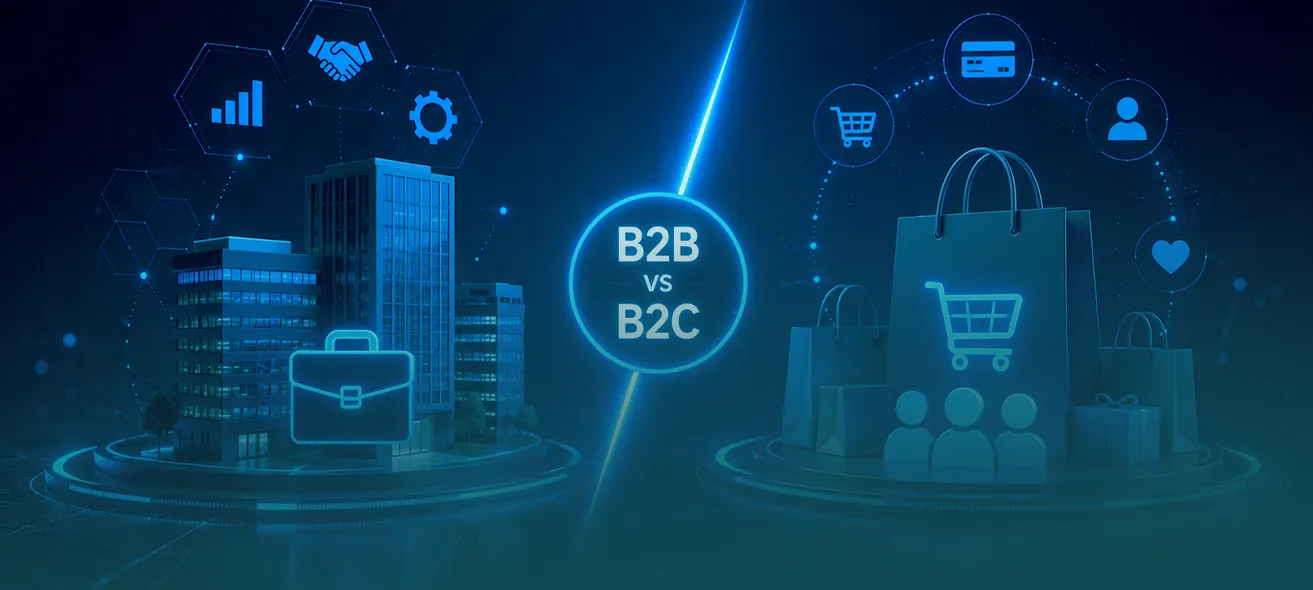
Do all e-commerce stores sell the same way? When you hear the term ‘e-commerce,’ you might imagine a store displaying products that customers buy directly. However, the reality is much deeper; behind every digital sale lies a business model that defines the mindset, marketing strategy, and even the nature of the relationship with the customer.
This leads to a very important question: What is the difference between B2B and B2C in e-commerce? And why is understanding it considered the secret to success in any digital project? In this article from Sard, we will understand the types of e-commerce, how to choose the right model for your project, and B2B vs. B2C in terms of marketing, purchasing behavior, and strategies.
B2B vs. B2C: How do digital markets work and what are the secrets behind their differences?
When discussing the world of e-commerce, one must first understand the foundation upon which all commercial operations are built: the nature of the relationship between the seller and the buyer. This is where the two main models of the digital economy emerge: B2B and B2C.
What is the Business-to-Business (B2B) model?
The B2B model is an abbreviation for ‘Business to Business,’ referring to commercial transactions that take place between companies, rather than between a company and an end consumer. Simply put, you are not selling to individuals here; you are selling to other companies that rely on your products or services to run their operations.
Examples of the B2B model:
- A software company providing an inventory management system for retail stores.
- A factory supplying products to wholesalers.
- A marketing agency providing services to companies and brands.
Advantages of the B2B model:
- High-value deals.
- Long-term business relationships.
- Purchasing decisions based on analysis and logic.
- A longer sales cycle, but one that is more stable and sustainable.
In this model, products are often part of a production chain, such as raw materials or technical services used to develop a final product.
What is the Business-to-Consumer (B2C) model?
The B2C model is an abbreviation for ‘Business to Consumer,’ referring to direct sales from a company to the end consumer. Here, the customer is an individual looking for a product that directly meets their personal needs.
Examples of the B2C model:
- An online store selling clothing and footwear.
- Food delivery apps.
- Electronics stores targeting individuals directly.
Advantages of the B2C model:
- Quick and easy purchasing decisions.
- A broad and diverse audience.
- Repeat sales.
- Greater reliance on visual and emotional content in marketing.
In this model, the product is ready for final use and is sold directly to the consumer without intermediaries.
Simply put: Understanding the difference between B2B and B2C is not just theoretical knowledge; it is a strategic foundation that helps you accurately define your sales method, marketing style, and target audience. The better you understand the nature of the market you operate in, the greater your ability to build a successful strategy that achieves growth and stability in the e-commerce world.
The difference between B2B and B2C: How does the sales method differ based on the type of customer?
When talking about e-commerce, it is not enough to know ‘what we sell’; more importantly, we must know ‘to whom we sell.’ The difference in customer type—between companies and individuals—completely changes the way we think about marketing, sales, and even product development. Here is a detailed comparison:
Comparison Element |
B2B (Business to Business) |
B2C (Business to Consumer) |
| Target audience | Companies and organizations. | Individuals (end consumers). |
| Nature of the customer | Professional entities and teams. | Individuals making personal decisions. |
| Type of purchasing decision | Logical, analytical, and involves multiple parties. | Fast, individual, and potentially emotional. |
| Sales cycle | Long and requires multiple stages. | Short and fast. |
| Deal value | High, often involving large contracts. | Low to medium. |
| Purchase frequency | Lower, but with ongoing contracts. | Higher, with repeat purchases. |
| Marketing style | Educational content, case studies, and building trust. | Visual content, offers, and direct motivation. |
| Customer relationship | Long-term and strategic partnerships. | Simpler and shorter-term relationship. |
| Decision-making process | Relies on a team, budget, and research. | Usually relies on one person. |
| Type of products | Solutions, services, raw materials, systems. | Ready-to-use products. |
| Marketing channels | LinkedIn, email, conferences. | Social media, ads, online stores. |
| Role of content | Logical persuasion and building long-term trust. | Quick attraction and purchase motivation. |
| Target market size | Relatively limited but high value. | Very broad with a large number of customers. |
This comparison can be summarized simply: B2B is a sale based on logic, strategy, and building long-term relationships, while B2C is a sale based on quick experience, direct persuasion, and emotional impact.
Understanding the difference between B2B and B2C is not just theoretical information, but the foundation for the success of any project in the e-commerce world today.
Learn now about the types of e-commerce and their relationship to B2B and B2C
When we talk about e-commerce, it is not limited to selling from a company to a customer. There are several different models that control how things are handled within the digital market, and each model has its own approach to marketing, sales, and profit generation. Among the most famous types of e-commerce are:
B2B: Business to Business
In this model, a company sells its products or services to another company, such as software companies, suppliers, or marketing agencies that deal with institutions and businesses.
B2C: Business to Consumer
This is the most common model in e-commerce, where companies sell their products directly to individuals via online stores or apps.
C2C: Consumer to Consumer
This model relies on sales transactions between individuals themselves via digital platforms, such as websites for selling used products or classified ad apps.
C2B: Consumer to Business
Here, individuals provide their services or products to companies, such as freelancers working in design, marketing, or programming for institutions.
Despite the diversity of e-commerce models, B2B and B2C remain the most influential and widespread in global and Arab markets, as they constitute the largest part of buying and selling activity within the modern digital economy.
If you are thinking about entering the world of digital commerce or developing your current project, understanding the types of e-commerce is your first step toward success.
E-commerce models: How to choose the right model for your project’s success?
Choosing an e-commerce model is not just a random step; it is a strategic decision that directly affects your marketing method, growth plan, and even the volume of profits your project can achieve in the future. To choose the right model, you must first understand the nature of your business and your target audience, because each business model suits a different type of customer and market.
Some of the most important factors that help you determine the most suitable model:
- Nature of the product or service: Are you providing solutions aimed at companies or products customized for individuals?
- Target market size: Some projects target a wide audience of consumers, while others rely on a limited number of specialized companies and clients.
- Growth and expansion strategy: The method of expansion differs in B2B compared to B2C, whether in marketing, relationship building, or sales volume.
- Marketing budget: Marketing to individuals often relies on advertising campaigns and visual content, while marketing to companies requires building trust and long-term relationships.
- Customer type and purchasing behavior: An individual customer makes their decision relatively quickly, while companies require study and analysis before completing any deal.
In general: If you are targeting companies and institutions, the most suitable model for you is B2B. If you are selling directly to individuals and consumers, the B2C model is the best choice. More important than choosing the model itself is understanding how to interact with your audience and build an experience that suits their needs and expectations within the digital market.
Most common questions about the difference between B2B and B2C
Which is better: B2B or B2C?
There is no absolute ‘better’ model; it depends on the nature of the project, the target audience, and the business goals.
Does marketing in B2B differ from B2C?
Yes, marketing in B2B relies more on building trust, educational content, and long-term relationships, while B2C focuses on emotional impact, offers, and quick experience.
Can a company work with both B2B and B2C systems together?
Certainly, there are many companies that sell to both businesses and individuals at the same time, with different marketing and pricing methods for each category.
What is the most used model in e-commerce?
The B2C model is considered the most widespread in online stores, while B2B achieves wide prevalence in services and solutions aimed at companies.
How do I know the right model for my project?
This depends on the type of product or service and the audience you are targeting. If your clients are companies, the appropriate model is B2B; if you are targeting individuals, B2C is better.
Which of the two models is more suitable for beginners?
This depends on the nature of the product and the target audience, but B2C is easier at the beginning in terms of reaching the audience, while B2B requires more experience in building relationships and managing deals.
Now the picture is clearer… so choose what suits you and start with confidence
After learning about the difference between B2B and B2C, you have a clearer vision regarding the types of e-commerce and their various models. You can now make a smarter decision regarding the right direction for your project. Start now by analyzing your audience and defining the nature of your product, then build your strategy on a clear and studied foundation, because success does not start with selling alone, but with understanding the path that leads you there.