In the past, artificial intelligence was viewed as a futuristic idea found in movies and science-fiction stories. Today, however, it has become an essential part of everyday life, often without people even realizing it. From the moment we wake up until the end of the day, intelligent systems contribute to making decisions, analyzing data, and delivering services that make life faster, more accurate, and more efficient.
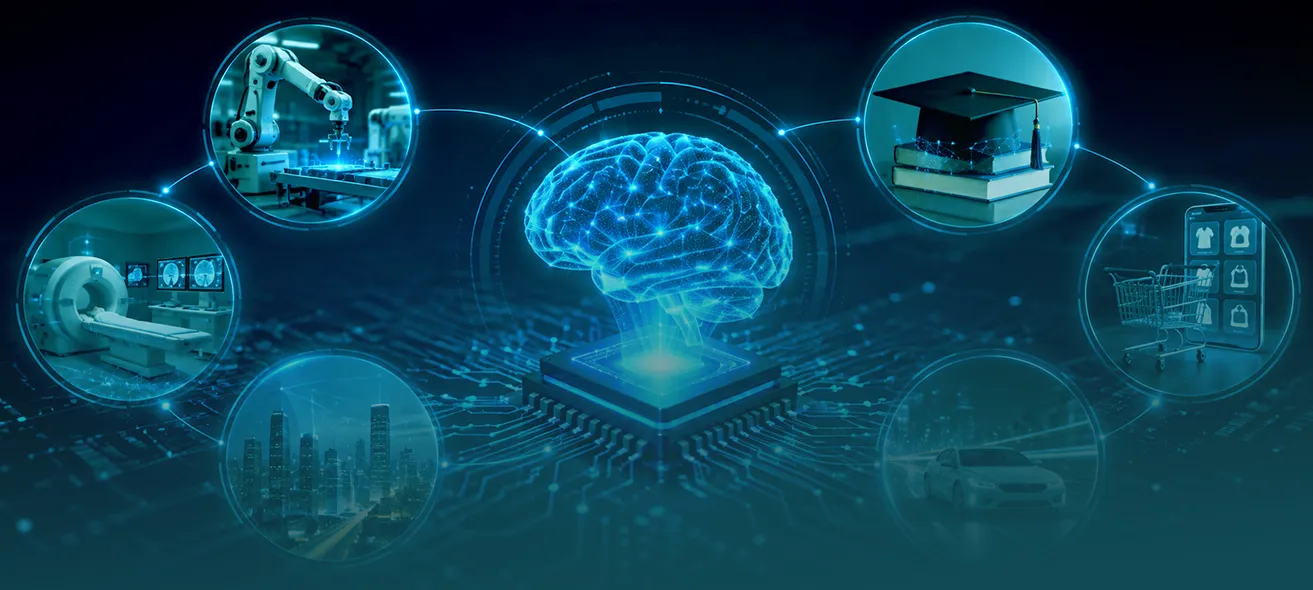
The fields of artificial intelligence in life are no longer limited to technology laboratories or major corporations. They have expanded into education, healthcare, commerce, transportation, financial services, and even smart homes. In this comprehensive guide from Sard Blog, we explore the most important fields where artificial intelligence has created real change and how this technology has become an integral part of the present and the future.
What Is Artificial Intelligence? The Real Concept Without Programming Complexity
Artificial Intelligence (AI) is a branch of computer science focused on creating systems and software capable of simulating human cognitive abilities and performing tasks that were once exclusively dependent on the human mind.
The Secret Behind the Digital Explosion: Why Are the Fields of Artificial Intelligence in Life Expanding So Quickly?
The massive spread of artificial intelligence did not happen by chance. It resulted from the convergence of several technological and economic factors that transformed AI from a specialized technology into an essential component of different industries and everyday activities. Among the most important factors are:
- The massive growth of digital data: Individuals and organizations now generate enormous amounts of data every day. This has provided the essential fuel AI systems need for learning, analysis, and prediction.
- Major advances in computing power: Modern processors and cloud computing have made it possible to perform complex operations and analyze millions of data points within seconds, making AI applications more efficient and affordable.
- The widespread adoption of smartphones and connected devices: Smart devices have created an ideal environment for collecting data and running intelligent applications, accelerating the integration of AI into everyday life.
- The growing need for automation and productivity: Companies and organizations are seeking to reduce routine work, improve operational efficiency, and save time and costs. As a result, AI has become a strategic option for achieving these goals.
- The need for faster and more accurate decision-making: Modern organizations rely on intelligent analytics to extract insights and predictions from data, helping them make informed decisions instead of relying on assumptions.
- Global competition in innovation and digital transformation: Competition between companies and countries has driven significant investment in AI technologies, which are increasingly viewed as major drivers of economic growth and technological development.
- Greater access to intelligent tools and platforms: AI technologies are no longer limited to large corporations. Individuals and small businesses can now access ready-made platforms and services, accelerating global adoption.
However, the real value of artificial intelligence is not found in theories or laboratories, but in the everyday applications that have become part of people’s lives and organizations. Below, we explore the most important fields where this technology has created a fundamental transformation.
The Complete Map of Artificial Intelligence Fields in Everyday Life
When we talk about technology becoming deeply integrated into our daily lives, we are no longer talking about a futuristic luxury. Instead, we are discussing a fundamental engine that is reshaping the world around us. Here is a detailed guide to how artificial intelligence is transforming 10 major sectors of our lives and work:
Artificial Intelligence in Education
Education is no longer restricted to traditional and standardized methods. AI is helping create flexible learning experiences that adapt to individual students and maximize their learning potential:
- Personalized learning: Analyzing a student’s learning speed and weaknesses to provide educational content suited to their individual abilities.
- Automated grading: Evaluating tests and essays quickly and accurately, allowing teachers to spend more time focusing on teaching and explanation.
- Intelligent educational assistants: Chatbots provide students with instant and simplified answers to their questions around the clock.
- Curriculum development and performance analysis: Studying overall student performance to identify educational gaps and improve curricula accordingly.
Artificial Intelligence in Medicine and Healthcare
In healthcare, technology does more than simplify administrative tasks. It can play an important role in improving diagnosis, treatment, and patient monitoring:
- Early diagnosis: Helping identify complex diseases and tumors at earlier stages, sometimes with performance that can complement or exceed human assessment in specific tasks.
- Medical image analysis: Analyzing X-rays, MRI scans, and other medical images rapidly to support healthcare professionals.
- Drug discovery: Simulating chemical interactions computationally to accelerate the development of new medicines and vaccines.
- Remote patient monitoring: Using wearable smart devices to monitor vital signs and send alerts to healthcare professionals when potential problems are detected.
Artificial Intelligence in Business
To understand how companies use artificial intelligence today, it is necessary to look beyond technology and consider its role in management, efficiency, and business growth:
- Customer service: Automated systems and digital agents can respond to thousands of inquiries simultaneously while reducing operational costs.
- Sales forecasting: Analyzing complex market data and predicting future demand to help businesses reduce unexpected losses.
- Inventory management: Tracking product movement and alerting management when specific products need to be replenished before stock runs out.
- Customer behavior analysis: Studying customer interests and feedback to develop marketing strategies and services that better match actual needs.
Artificial Intelligence in E-Commerce
Digital stores have evolved from simple product-display platforms into personalized shopping environments designed to understand consumer behavior:
- Product recommendations: Intelligent recommendation engines analyze browsing behavior and previous purchases to suggest products that may interest customers.
- Dynamic pricing: Automatically adjusting product and service prices based on demand, market conditions, and competitor pricing.
- Customer behavior analysis: Studying shopping patterns and predicting upcoming trends, helping stores prepare the right inventory in advance.
- Improving the shopping experience: Simplifying checkout processes and enhancing internal search tools to make shopping easier and encourage customers to return.
Artificial Intelligence in Banking and Financial Services
AI has become increasingly important in banking and financial services, particularly for improving security, efficiency, and customer experiences:
- Fraud detection: Systems monitor large numbers of financial transactions and identify unusual or suspicious activity to help protect customers.
- Risk analysis: Evaluating the creditworthiness of individuals and businesses while analyzing market conditions to support better financial decisions.
- Banking assistants: Intelligent support systems answer customer questions and can assist with services such as transfers and account-related requests without requiring a branch visit.
Artificial Intelligence in Transportation and Modern Vehicles
The integration of artificial intelligence into vehicles has transformed the concept of driving, making it safer, smarter, and more convenient:
- Driver assistance systems: Supporting drivers with tasks such as automated parking, lane keeping, and automatic braking to help avoid collisions.
- Predictive maintenance: Analyzing vehicle and engine performance to alert drivers when maintenance may be needed before a sudden breakdown occurs.
- Improving fuel efficiency: Selecting efficient routes and optimizing vehicle performance to reduce energy consumption and emissions.
- Self-driving vehicles: Advanced vehicles use sensors, radar, and computer vision to navigate and operate with limited or no direct human intervention, depending on the system.
Artificial Intelligence in Smartphones
Artificial intelligence has become an integral part of smartphones, acting as a smart assistant that remains close at hand throughout the day:
- Smart cameras: Automatically adjusting lighting, improving colors, and separating backgrounds to produce better photos and videos.
- Voice assistants: Executing commands, setting reminders, writing messages, and searching the web through voice interaction.
- Battery management: Studying app usage patterns and limiting unnecessary background activity to help extend battery life.
- Real-time translation: Translating written text and spoken conversations using cameras or microphones to make communication across languages easier.
How Will Artificial Intelligence Change the Way We Live in the Coming Years?
What we are witnessing today may only be the beginning. The rapid development of AI technologies suggests that the coming years will bring deeper transformations affecting work, education, healthcare, and even everyday decision-making. Some of the expected changes include:
- More intelligent personal assistants: Digital assistants will evolve from simple command-based tools into proactive partners capable of understanding habits and preferences and offering useful recommendations.
- Predictive healthcare: Intelligent systems will increasingly analyze health indicators and identify potential risks before symptoms appear, supporting early prevention and better healthcare.
- Learning experiences designed for each individual: Education will move toward highly personalized learning paths that adapt to students’ abilities, learning speed, and career goals.
- The emergence of entirely new professions: Just as previous industrial revolutions eliminated some jobs while creating others, AI will lead to new careers related to intelligent systems, data analysis, and technology solutions.
- Smarter and more sustainable cities: Future cities will use intelligent systems to manage traffic, energy, water, and public services more efficiently, improving quality of life and reducing waste.
- Faster and more accurate organizational decisions: Predictive analytics will become an essential part of decision-making in companies and governments, helping identify challenges and opportunities before they occur.
- More personalized digital experiences: Platforms and services will increasingly provide experiences tailored to individual users based on their actual needs and behavior.
- Greater automation across industries: Intelligent systems will take over more routine and repetitive tasks, allowing people to focus on creativity, innovation, and complex human decision-making.
These transformations confirm that artificial intelligence will not simply change the tools we use. It will reshape the way we live, learn, and work over the coming decades.
Challenges and Risks Associated With the Spread of Artificial Intelligence
Although artificial intelligence has become an important part of advancing education and business, its widespread adoption also brings significant challenges that cannot be ignored. These issues remain central to discussions about digital transformation. The most important challenges include:
- Privacy and data protection: AI systems depend on large amounts of data to improve their performance and make decisions, raising concerns about how this information is stored, protected, and used.
- Algorithmic bias: AI systems can sometimes be influenced by biases present in their training data, potentially producing unfair results or reinforcing existing patterns of discrimination.
- Job displacement: As automation and intelligent systems become more common, some traditional roles may experience reduced demand, particularly jobs based heavily on repetitive tasks.
- Overdependence on technology: Excessive reliance on technology may weaken critical-thinking skills and encourage dependence on ready-made solutions, making it important to maintain a balance between human intelligence and artificial intelligence.
Although this article focuses on the fields of artificial intelligence in life, the full picture is not complete without understanding the most important uses and practical applications of AI in education, healthcare, business, and digital commerce, which we have discussed in detail in a separate comprehensive guide.
Frequently Asked Questions
Can Artificial Intelligence Be Used Without a Constant Internet Connection?
Yes. Some AI applications can operate without an internet connection, particularly features built directly into smartphones or locally installed software. However, many advanced AI systems depend on cloud connectivity to access updated models, data, and processing capabilities.
Which Field Has Benefited the Most From Artificial Intelligence So Far?
Financial technology and e-commerce are among the fields that have benefited significantly from AI, followed by education and healthcare. AI has helped these sectors improve efficiency, analyze data, and provide more personalized user experiences.
What Skills Will Be Most Important for Working With Artificial Intelligence in the Future?
Key skills include analytical thinking, data literacy, digital-tool proficiency, creativity, and problem-solving. These skills complement artificial intelligence rather than simply compete with it.
Will Artificial Intelligence Replace Humans and Eliminate Jobs Completely?
No. Artificial intelligence is unlikely to eliminate the role of humans entirely. Instead, it is more likely to automate or transform many repetitive tasks while increasing the value of skills that require creativity, judgment, communication, and complex problem-solving.
What Is the Difference Between Artificial Intelligence and Traditional Automation?
Traditional automation follows predefined rules to perform specific tasks, while artificial intelligence can analyze data, identify patterns, adapt to certain situations, and support decisions in ways that go beyond fixed instructions.
Build Your Future Before Someone Else Builds It for You!
By the end of our journey, it becomes clear that the fields of artificial intelligence in life are no longer simply technologies that we can choose to use or ignore. They have become an invisible infrastructure influencing many aspects of our reality and contributing to everyday decisions. We are not waiting for the future; we are already living in it.
The next equation is simple and decisive: the world will not be divided into humans and robots. Instead, it will increasingly be divided between people who know how to use artificial intelligence to enhance their abilities and those who choose to ignore it. The choice is yours. Are you ready to make this hidden partner one of your strongest tools for success and growth?