Can you imagine that your old belongings could become a business generating thousands of dollars? In just a moment, an old phone you no longer use, a piece of furniture you don’t need, or even a skill you possess can turn into a real online deal without the need for a company, a store, or huge capital.
This isn’t the future of commerce; it is the reality we live in today. This is the power of the C2C model—a world that is simple in form but capable of creating massive buying and selling activity between individuals, turning anyone into a potential seller with the click of a button. In this article from Sard we will understand together how consumer-to-consumer sales work, and why it has become one of the most important types of e-commerce and the most widespread and influential in the modern digital economy.
What is the meaning of C2C? And how did it change the concept of modern commerce?
In the past, commerce was associated only with companies and stores. Today, the landscape has changed completely, as anyone can sell a product or service directly to another person online with ease. This is where this concept emerges as one of the most widespread models in the modern digital commerce world.
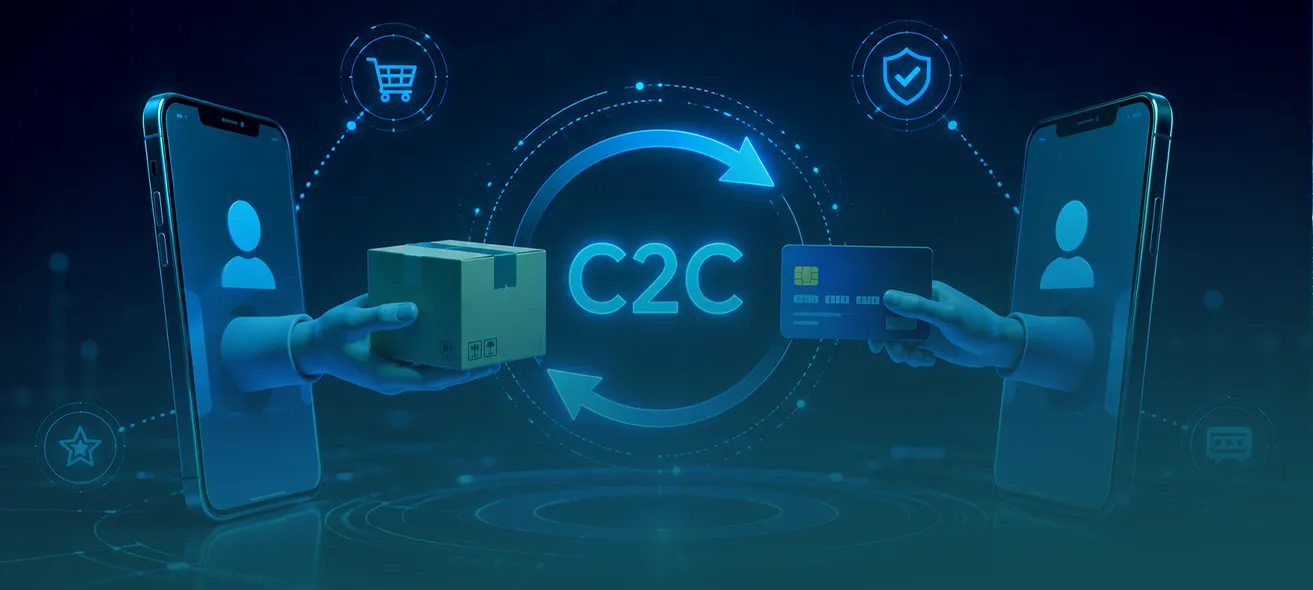
It stands for ‘Customer to Customer,’ referring to the consumer-to-consumer sales model, where buying and selling transactions take place directly between users without a company acting as the primary seller of the product.
In simpler terms:A person owns a product or service and lists it on a digital platform. Then, another person interested in buying it communicates with them to complete the deal easily through that platform. The platform acts as a smart intermediary that facilitates the entire process, from listing products to payment, reviews, and sometimes shipping, which is why this model has grown at a tremendous rate in recent years.
This model is no longer limited to selling used products as it was in the beginning; it now includes a wide and diverse range of areas such as:
- Selling handmade products and creative crafts.
- Digital services and freelancing.
- Real estate and car rentals.
- Online auctions.
- Reselling rare products and collectibles.
- Selling used clothing and accessories.
With the development of e-commerce and smart applications, this model has become a fundamental part of the modern digital economy, especially with millions of users relying on platforms like eBay, Etsy, Facebook Marketplace, and OLX for their daily sales.
The power of consumer-to-consumer sales lies in giving everyone the opportunity to enter the digital market without the need to start a company or possess huge capital, making it one of the fastest-growing and most influential types of commerce worldwide.
Why did the C2C model spread so quickly? Because it opened the door to commerce for everyone.
The secret wasn’t just in selling, but in the fact that ‘everyone can now sell.’ The massive success achieved by this model didn’t come from nowhere; it changed the concept of traditional commerce entirely and made entering the world of e-commerce easier than ever before.
Instead of needing a large company or huge capital, anyone can start selling and earning directly online with very simple steps. Today, any individual can:
- Sell products they no longer need.
- Launch a small business from home.
- Offer their digital services and skills.
- Generate additional income from hobbies or handicrafts.
This is precisely what made consumer-to-consumer sales a fundamental part of the modern digital economy, especially with the proliferation of platforms that have facilitated buying and selling processes like never before.
So, what made the C2C model spread so quickly?
There are a set of powerful factors that helped this model succeed and turn into one of the fastest-growing types of commerce in the world:
- Low startup costs: The seller does not need a physical store, a team, or a huge budget. All they need is a digital platform and a product or service that can be easily listed.
- Fast access to customers: Platforms for this model have millions of active daily users, giving the seller the opportunity to reach a huge audience in a short time.
- Diversity of products and services: Almost everything can be sold within this model, from used products to digital services, handicrafts, and rare items.
- Ease of use: Modern platforms have made the buying and selling process very simple, even for users who have no technical experience.
- Great flexibility: Through it, anyone can be a seller and a buyer at the same time, which has created a flexible and fast-moving commercial environment.
- Supporting sustainability and reuse: This model has helped reduce waste and given used products a new chance for use instead of being discarded.
- Creating specialized digital communities: Some of its platforms are no longer just places for selling, but have become communities that bring together people with shared interests, such as fans of rare products, handicrafts, or vintage fashion.
As e-commerce continues to evolve, this model has become more than just a way to sell; it has turned into a real opportunity for anyone who wants to enter the digital world and generate profit in a flexible and easy way.
From a simple ad to a completed deal… this is how the consumer-to-consumer sales journey begins
Now that we know the importance of this model in e-commerce, it is time to learn how it works step-by-step. It does not rely on complexity or long procedures, but is based on a simple and smart idea: connecting individuals to each other via a digital platform that facilitates direct and secure buying and selling.
Despite its apparent simplicity, there is an integrated system behind it that goes through several organized stages to make the user experience smooth and effective:
1. Creating the listing (the starting point)
The journey begins when the seller adds their product or service to the platform, with clear photos, an accurate description, and a reasonable price that reflects its condition and value. The more professional and clear the listing, the greater the chances of attracting buyers quickly.
2. The product appears to interested parties
After posting, the platform displays the product to relevant users based on search queries, categories, or similar interests. This way, the ad reaches the people most likely to make a purchase decision.
3. Interaction and negotiation
In this stage, communication begins between the seller and the buyer, where questions can be asked, additional details requested, or even the price and delivery method negotiated. Here, the element of ‘trust’ begins to play its real role within the deal.
4. Secure payment completion
Most platforms for this model provide integrated or secure electronic payment systems that guarantee the rights of both parties and reduce risks. Some also add protection or guarantee systems until the delivery process is successfully completed.
5. Delivery or shipping
After the agreement is finalized, the product is shipped or delivered according to the agreed-upon method, whether through shipping companies or direct handover between the parties. Delivery options vary depending on location, product size, and order speed.
6. Review and reputation building
In the end, each party leaves their review of the experience, whether for the seller or the buyer. This review is not just a final step, but the foundation for building trust within the platform, and it directly affects future sales opportunities.
It can be said that this model turns the sales process from just a transaction into an integrated experience based on interaction and trust, without the need for a traditional store or complex infrastructure—just a smart platform that connects people in moments.
Famous C2C examples: Platforms that started as simple ideas and became empires
There are many platforms that have succeeded in building a global model based on direct user-to-user sales. Among the most famous examples:
- eBay: One of the oldest consumer-to-consumer sales platforms in the world, relying on auctions and direct sales.
- OLX: A classified ads platform that allows for the sale of used and new products locally.
- Facebook Marketplace: Transformed Facebook into a huge marketplace for buying and selling between users.
- Etsy: A platform specialized in selling handmade products and creative crafts.
- Airbnb: Despite the different idea, it is considered part of this model because individuals rent their properties to other individuals.
These platforms have proven that e-commerce is no longer exclusive to companies.
Types of e-commerce: How do sales models differ from C2C to B2B and B2C?
To understand the types of digital commerce more deeply, one must look at the way sales are conducted and who is the party behind each buying or selling process. The difference in ‘who sells to whom’ is what determines the entire model. Below is a simple comparison showing the most famous types:
Model |
Sales Method |
Example |
| B2B | Company selling to a company | A software company providing a business management system |
| B2C | Company selling to a consumer | An online store selling clothes |
| C2C | Individual selling to an individual | A person listing their phone for sale on a platform like OLX |
| C2B | Individual selling to a company | A freelancer providing design or content writing services |
What distinguishes the individual-to-individual model from others?
The fundamental difference is that it is based entirely on transactions between individuals, without a company as a primary party in the deal. This makes it easier and closer to a personal nature, as the sale relies heavily on direct trust and communication between the two parties.
If you want a deeper understanding of e-commerce types and how to choose the most suitable model for you, start researching and applying now instead of just watching.
The future of the C2C model: Why do experts expect it to grow massively over the coming years?
This is because it is witnessing tremendous development with the spread of the digital economy and the increasing reliance on smartphones and social media platforms. Its growth is expected to continue due to:
- The rise of the resale culture.
- The spread of the sharing economy.
- The growth of freelancing.
- The development of electronic payment methods.
- The ease of creating stores and platforms.
Artificial intelligence has also begun to play a major role in improving the user experience within consumer-to-consumer sales platforms.
The most important frequently asked questions that might be on your mind
Can you make a profit from C2C?
Yes, you can profit by selling used products, reselling, or offering personal or digital services.
What are the most famous platforms that rely on individual-to-individual sales?
Platforms like OLX, eBay, and Facebook Marketplace are among the most prominent examples of this model.
Does this model require significant experience?
Not necessarily, but it requires skill in listing products, communicating, and building trust with buyers.
Is this model safe?
Safety depends on the platform used, as some platforms provide protection systems and reviews that reduce risks.
Your opportunity starts with a decision… don’t wait for the market, make your place in it!
If you are thinking about entering the world of e-commerce or want to leverage your skills and sell your products in a smart way, the C2C model might be the perfect starting point for you. Start today, experiment, learn, and improve your sales method. Don’t wait for the opportunity… create it yourself.
Start your journey now in understanding and applying e-commerce types, and discover which model suits you to build your project with confidence and professionalism.